First cohort starts Wednesday 28 October 2026

First cohort starts Wednesday 28 October 2026
Certified AI Governance Expert Foundation (CAIGE-F)
Don’t Just Learn AI Governance. Learn How to Do the Work, Build the Evidence and Demonstrate Your Competence.
Learn to find, assess and govern the AI an organisation runs, one practical artefact at a time.
Watch · 28 min
AI Governance Is Two Years Old. That Is Your Advantage.
19 weeks · 6 parts · 19 modules · Online with live mentoring
Founding cohort starts in: 07:00:00:00
70,000+
Professionals trained
137
Countries
#1 & #2
EU AI Act bestsellers
Certified AI Governance Expert Foundation
What Sets CAIGE-F Apart Is Depth
CAIGE-F trains experienced professionals to do the governance work itself, from the first inventory to the board paper.
The programme prepares you to find the AI an organisation runs, interrogate its technical evidence, recognise how it fails, assess and allocate its risk, classify it against regulation and present governance to a board.
Many courses teach vocabulary and regulation. CAIGE-F also teaches how systems are built, tested, monitored and fail.
Part Two alone is 203 lessons on the system lifecycle.
For employers, the reason is simple
Someone who cannot read the evidence behind a system cannot govern it.
A CAIGE-F graduate can ask a data science team the right questions and judge the answers.
Structure · CAIGE-F · 2026
The Programme at a Glance
Nineteen weeks, one module released each week, built to fit around a working schedule.
19 weeks
One module released each week
6 parts
19 modules, 93 sub-modules
574
Video lessons: 567 teaching plus 7 assessment briefings
7–11 min
Length of each lesson
57–60 h
Taught hours in total
1 year
Support and live weekly mentoring labs
How you study
Weekly Video, Live Every Wednesday
Lessons are online, self-paced weekly video.
Short lessons of 7 to 11 minutes fit into a working day.
Every Wednesday, live group mentoring brings the cohort together to discuss the week’s work and the artefact in progress.
Who it is for
Professionals Taking On Responsibility for AI
There are no formal prerequisites, but professional experience is assumed.
The course suits people from privacy, legal, risk, compliance, audit and technology roles who are taking on responsibility for AI.
Successful learners earn the CAIGE-F credential.
Table 1 · The Six Parts
Six Parts, Six Questions a Governance Professional Must Answer
Each module has three action-based objectives and produces one practical artefact.
Part
Question it answers
Weeks
Modules
Lessons
One. Understand What You Are Governing
What am I governing?
1–4
4
119
Two. Understand Where Governance Attaches
Where does governance attach?
5–8
4
203
Three. Understand What Goes Wrong
What goes wrong?
9–10
2
53
Four. Understand the Response
How do we respond?
11–14
4
83
Five. Understand the Rules
What are the rules?
15–18
4
91
Six. Do the Job
How do I build and run this?
19
1
18
Why the Parts Follow This Order
The sequence mirrors the real job. You first learn what AI is and where it sits in your organisation.
You then follow a system through its lifecycle, study how it fails, and build the response: risk assessment, assurance and vendor review.
Regulation comes after you understand the systems it applies to, so you can classify real cases rather than memorise rules.
The final week brings everything together into a governance programme you can run.
Assessment · CAIGE-F · 2026
You Learn by Doing the Job
Applied assessment is the heart of the programme. Knowledge checks confirm the learning; the artefacts and applied assessments prove you can do the work.
The core
6 + 1 · about 19.5 hours
Applied Assessments and Capstone
Six extended applied assessments and a capstone, where you apply each part to realistic governance work. These are the tasks a governance lead faces in practice, not recall exercises.
The core
19 artefacts
Weekly Artefacts, Ready to Use at Work
Every module produces a practical artefact, from an AI inventory to a classification memo and a board paper. You finish the course with a working governance file.
Knowledge checks
19
Module quizzes, checking understanding week by week
6
Examinations, one closing each part
409
Questions in total across quizzes and examinations
This is what sets CAIGE-F apart: graduates show their competence through work products an employer can read, not only through a test score.
Weeks 1–4 · 4 modules · 119 lessons
Part One: Understand What You Are Governing
Part One builds the foundation: what the job involves, how AI works and where your organisation already uses it.
Module 01
14 lessons
The AI Governance Job
What the role involves day to day and what your background already covers. Map the AI value chain: builder, supplier, deployer and affected party. Build a first-pass AI inventory, including unapproved systems.
Artefact: AI system inventory
Module 02
30 lessons
AI Foundations
Explain how AI learns to non-technical colleagues, and use core vocabulary with confidence, including the difference between training and inference.
Module 03
41 lessons
Models, Algorithms and the Stack
Tell model types apart, understand algorithm families and deep learning at governance level, and see where obligations attach in the data and physical stack.
Module 04
34 lessons
Generative and Agentic AI
How large language models produce output and why they fail, what controls exist and where they stop working, and the risks of autonomy and tool use.
For the organisation
By week 4 the learner has started a real inventory of the AI in use, often the first complete view the organisation has.
Sample lesson · Module 1
Watch a Sample Lesson: Upstream vs Downstream
About this lesson
You ask what the model was trained on.
Your supplier cannot tell you, because they licence it from a company you will never get a meeting with.
What to do when upstream goes dark, without either waving it through or blocking it.

▶
Sample lesson · 8 min
A sample from Module 1, The AI Governance Job, on placing an organisation in the AI value chain.
▶ Watch the Sample LessonWeeks 5–8 · 4 modules · 203 lessons
Part Two: Understand Where Governance Attaches
The largest part of the programme follows a system from design to retirement, so you know where each obligation applies.
Module 05
49 lessons
Designing an AI System
Lifecycle obligations for built and procured systems; interrogate purpose, affected populations and success criteria; assess data provenance, labelling and representativeness.
Module 06
57 lessons
Building and Testing
Read a confusion matrix, treat precision versus recall as a business decision and judge whether a test set is trustworthy.
Artefact: fairness and performance question set
Module 07
41 lessons
Deploying, Monitoring and Retiring
Specify monitoring and accountability, explain model drift, and design decommissioning and evidence retention.
Module 08
56 lessons
Privacy Across the Lifecycle
Apply data protection law at each stage, run an AI data protection impact assessment (DPIA) and assess automated decision-making safeguards.
Weeks 9–10 · 2 modules · 53 lessons
Part Three: Understand What Goes Wrong
Governance starts with an honest view of failure. Part Three teaches you to see harm, bias and attack before they reach real people.
Module 09
28 lessons
Harms, Bias and Failure Modes
Name harms as consequences to real people
Trace where each bias enters the lifecycle
Apply a repeatable root cause method
Module 10
25 lessons
Security, Robustness and Incident Response
Threat-model a system, including prompt injection and data poisoning
Spot unlogged incidents and build a sourced timeline
State what the evidence cannot establish
What this means for the learner
You stop describing risk in abstract terms. Instead, you can say which group of people could be harmed, at which stage the problem entered, and what evidence supports that view.
What this means for the organisation
When something goes wrong, the organisation has someone who can reconstruct what happened from sources, separate facts from assumptions, and report clearly on the limits of what is known.
That discipline protects both the people affected and the organisation’s credibility.
Weeks 11–14 · 4 modules · 83 lessons
Part Four: Understand the Response
Part Four turns understanding into control: risk assessment, assurance, vendor review and human oversight.
Module 11
19 lessons
Risk and Impact Assessment
Classify by regime, category and date; place harms by probability and severity; record who accepts residual risk.
Artefact: inventory, risk classified
Module 12
26 lessons
Assurance, Audit and the AI Management System
Assurance versus audit in three lines of defence; the evidence a management system must generate; what to automate and what needs human judgement.
Module 13
21 lessons
Third Party and Vendor AI
Find what AI suppliers run, conduct vendor AI reviews and recognise when a deployer becomes a provider.
Artefact: vendors assessed against the inventory
Module 14
17 lessons
Ethics, Trustworthy AI and Human Oversight
Apply principles to a specific system, specify oversight in operational terms, and assess explanations and challenge routes.
For the organisation
The inventory begun in week 1 now carries risk classifications and vendor assessments, with named owners for residual risk.
Weeks 15–18 · 4 modules · 91 lessons
Part Five: Understand the Rules
With the systems understood, regulation becomes something you apply to real cases rather than a list to memorise.
Module 15
32 lessons
The EU AI Act
Applicability and operator role; risk classification with its route; high-risk obligations and conformity.
Artefact: classification memo and implementation roadmap
Module 16
17 lessons
Global Landscape Beyond the EU
Compare regulatory approaches, identify the regimes that apply to a multinational estate, and design governance that scales across jurisdictions.
Module 17
25 lessons
Sector Rules and High-Risk Use Cases
Employment and discrimination law in hiring; consumer, financial and healthcare obligations; emerging use cases.
Module 18
17 lessons
IP, Liability and Contracts
Ownership of inputs, models and outputs; where liability falls; drafting AI risk clauses.
For the organisation
This part produces a reasoned classification of its systems and a roadmap to meet obligations, written by someone who understands both the law and the technology it governs.
Week 19 · 1 module · 18 lessons
Part Six: Do the Job
The final week brings every part together into a governance programme you can build and run.
Module 19
18 lessons
Building and Running the Programme
Assess readiness and structural gaps
Design governance structure, terms of reference and an accountability map
Write a two-page board paper
Artefact
Board paper, ninety-day plan and accountability map
For employers
Graduates leave with work they can use inside the organisation straight away.
The board paper rests on the inventory, risk classifications and vendor assessments built across the course, so it describes your organisation’s real systems.
Fig. 1 · Weeks 1–19
One Inventory That Grows Into a Board Paper
Nineteen artefacts in total, built around one document rather than disconnected worksheets.
1
Week 1
Start the AI Inventory
You list the AI systems your organisation runs, including unapproved ones, and map who builds, supplies and deploys each.
2
Week 11
Risk-Classify It
Each entry gains a classification by regime, category and date, with harms placed by probability and severity and a named owner for residual risk.
3
Week 13
Test It Against Vendors
You check what your suppliers actually run and assess each vendor against the inventory.
4
Week 19
The Evidence Beneath the Board Paper
The completed inventory supports your two-page board paper, ninety-day plan and accountability map.
Fig. 1 The inventory journey across the programme.
Weekly rhythm · CAIGE-F · 2026
How Each Week Is Taught
Every module follows the same shape, so you always know where you are and what you are building.
01
Welcome Lesson
Where you are in the programme, a recall exercise from two or three modules back, the problem the module addresses, its three outcomes and the artefact you will produce.
02
Wrap-Up
What changed in your understanding, finishing the artefact, one action to take at work, and why the next module follows.
Weeks 7 and 13
Progress Checkpoints
Checkpoints after weeks 7 and 13 give you and your employer a clear view of progress before the later parts begin.
For experienced professionals
Ten-Question Diagnostic
Experienced privacy professionals can take a short diagnostic and skip foundational vocabulary they already know.
The recall exercise matters. By returning to material from earlier modules each week, the course keeps what you learned in Part One active when you need it in Part Five.

Jamal Ahmed
Director, Privacy Pros Academy
70,000+
Professionals trained
137
Countries
#1 & #2
EU AI Act bestsellers
Privacy Leader
of the Year
Meet your instructor
Jamal Ahmed
Jamal presents the programme and signs the certificate you earn.
Jamal Ahmed is an internationally recognised privacy and AI governance expert, global keynote speaker, bestselling author and founder of Privacy Pros Academy.
He has trained more than 70,000 professionals across 137 countries and built a global reputation for turning complex regulation into practical, real-world capability.
Jamal has delivered keynotes to organisations and institutions including the European Commission and has been recognised as Privacy Leader of the Year. His work has received multiple industry awards, including Best Contribution to the Industry, while his books on the EU AI Act have become international bestsellers and reached #1 and #2 in their Amazon category.
Through Privacy Pros Academy, Jamal has helped professionals build the confidence, credibility and practical expertise needed to advance their careers in privacy and governance.
He created the Certified AI Governance Expert (CAIGE) Accelerator to bring that same practical, career-focused approach to AI governance, developing professionals who can do the work, advise organisations and lead responsible AI governance in practice, not simply understand the theory.
“
Jamal has a clear talent for breaking down complex topics and presenting them in a way that is practical, engaging, and easy to understand.
Georgia Bakatsia · Legal Officer, European Data Protection Supervisor
Live weekly group mentoring every week with Jamal.
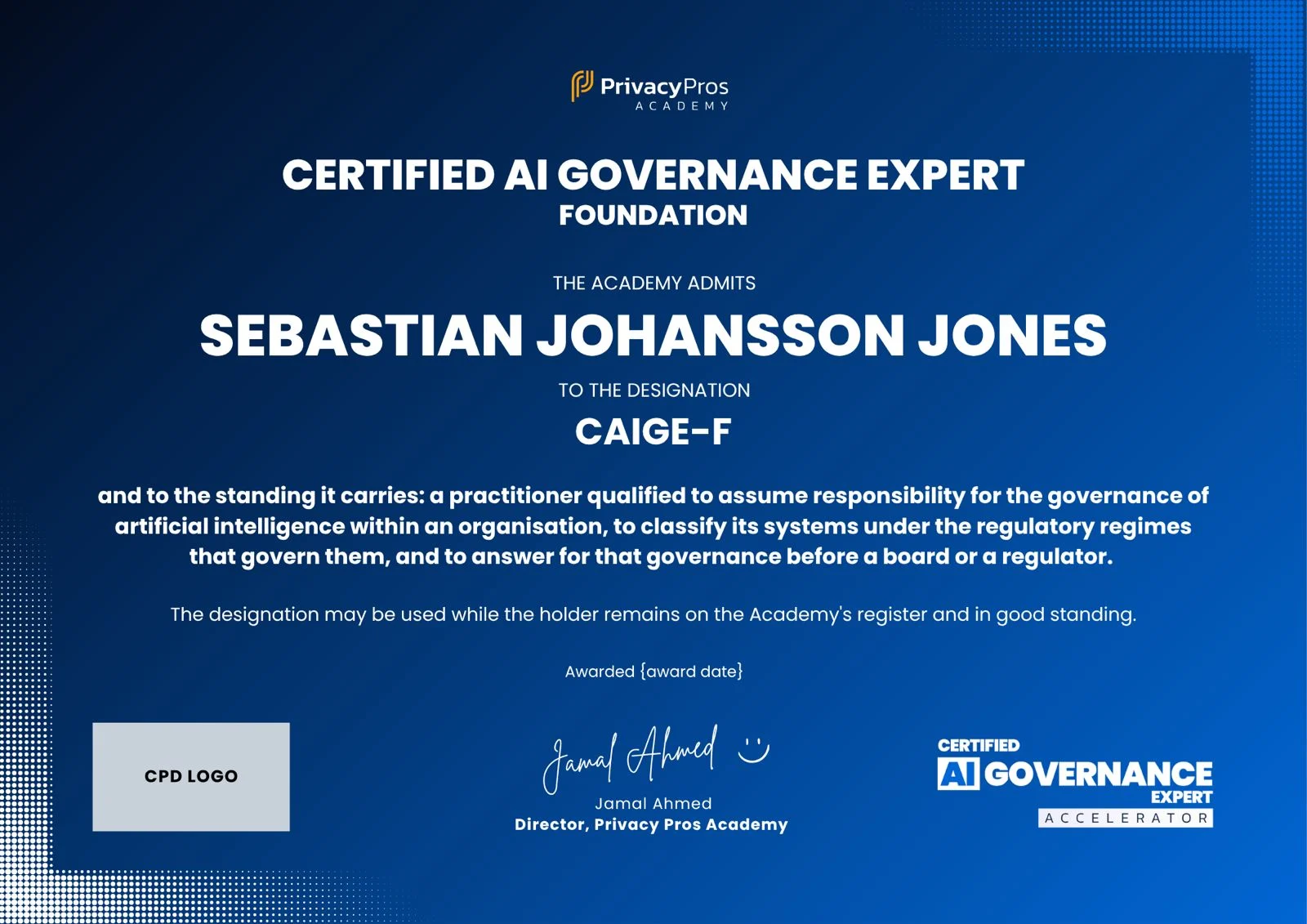
Certificate · CAIGE-F · 3 years
The Credential You Earn
Certified AI Governance Expert Foundation
Awarded by Privacy Pros Academy and signed by Jamal Ahmed, Director.
A practitioner qualified to assume responsibility for the governance of artificial intelligence within an organisation, to classify its systems under the regulatory regimes that govern them, and to answer for that governance before a board or a regulator.
Use the designation while you remain on the Academy’s register and in good standing.
CPD
Accreditation under assessment
Board-ready
Practitioner standing
CAIGE-F
Post-nominal designation
The founding cohort
Professionals From These Organisations Have Joined the Founding Cohort
Joined by DPOs, security leaders, lawyers, project managers and career pivoters across finance, healthcare, consulting, energy, government and education.











“
I see AI governance as a natural extension of the work I’m already doing… this program is about staying ahead of a rapidly evolving field.

Peter Armstrong
Cybersecurity Consultant
“
The people who truly understand how AI works and where the risks and failures are, are the ones who see the next challenge first. That’s where I want to be.

Chika Adams
Privacy Consultant
“
AI is moving into healthcare faster than the governance around it… I want to help shape how third-party AI is governed before it reaches patients.

Katarzyna Hardcastle
Senior Manager, Supplier Quality & Development
Your colleagues are already enrolling. Secure your founding-cohort place.
Design · Any jurisdiction
Built for an International Audience
01
The course is written for any jurisdiction and for second-language learners.
02
Scenarios use no country-specific institutions.
03
The language is plain: no idioms, metaphors or wordplay, and abbreviations are expanded on first use.
04
No questions test dates, penalty figures, case outcomes or the current status of instruments, so the assessments stay accurate as regulation changes.

Next step
Join the Founding Cohort on Wednesday 28 October 2026.
Nineteen weeks later, you finish with the CAIGE-F credential and a governance file.
Enrol now for one of the limited 100 founding cohort member seats and save 80%.
£5,000
£1,000
if you pay in full, or 3 × £400 monthly payments
Not sure yet? Book a quick chat →
More than 67 seats have already been secured. Don’t miss out!
Founding cohort starts in: 07:00:00:00


© 2026 Privacy Pros Academy LLC · 28 Geary St, STE 650 #341, San Francisco, CA 94108, USA